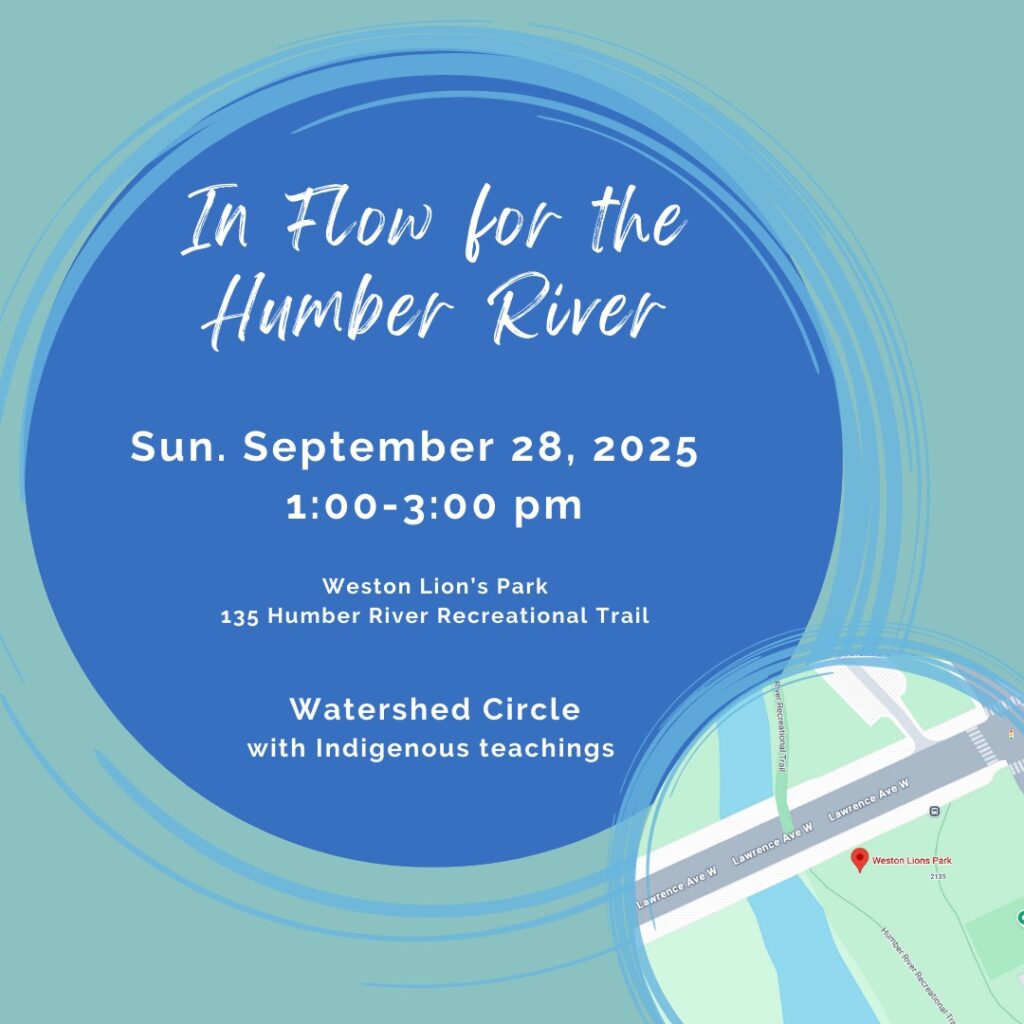

In Flow for the Humber River — Watershed Circle w Indigenous Teachings
Sun. September 28, 2025 —- 1:00-3:00 pm
Weston Lion’s Park — 135 Humber River Recreational Trail
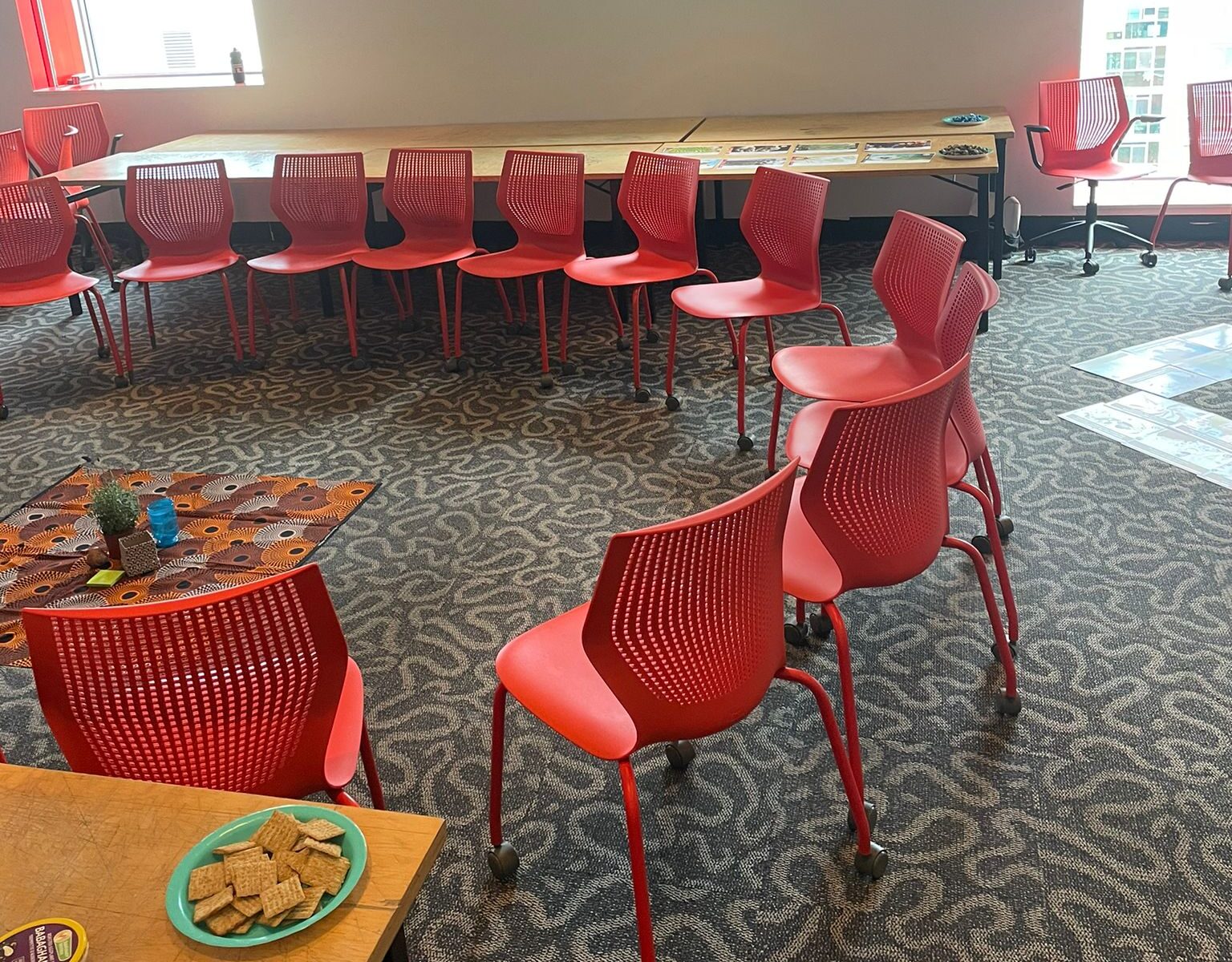
Like droplets of water pooling, this watershed-based circle invited local residents to explore their relationship to the Humber River and how this ecosystem can be protected and restored. In a watershed dialogue, we both share and learn how watershed health relates to our own well-being.
Our Future First guides rounds of dialogue that bring forward the embodied knowledge each person holds about the land and the water. While in circle along the shores of the Humber we become part of the river seeing itself through uncertainty into a desired future.
- Teachings about the Sacred Fire w. Melvin Pine, Turtle Island Carers of the Fire
- Teachings about Water w. Vivian Recollet Bigasohn Kwe
- Drumming w. Tabitha Shurgold
This watershed circle was delivered to protect, connect and celebrate Toronto’s ravines thanks to support from an InTO the Ravines grant.
Takeaways
| Theme | Community Insights | Recommendations |
|---|---|---|
| Urban Nature Protection & Restoration | –Residents are concerned about loss of mature trees (e.g., 1,500 trees clear cut) –overpaving upstream — insufficient incentives for naturalization to reduce impermeable surfaces — combined sewers exist in parts of Toronto –in-stream barriers prevent fish from migrating from Lake Ontario to upstream habitats — better erosion and sediment control needed during construction | –Strengthen city policies to protect existing tree canopy and mature green infrastructure. — Expand community-led and city-supported naturalization lot-level programs (e.g. rain gardens, permeable pavements) — naturalize Black Creek and water courses to promote fish habitat and spawning — collect fees from env damages for the procurement of lands to allow streams to evolve naturally and to reduce the need for engineered methods to protect property and infrastructure from erosion and flooding — development plans to minimize impact vegetation / design with nature |
| Cultural Recognition & Healing | –sacred medicines like sage and sweetgrass are cut down by city maintenance workers; –need for healing spaces and connection to the land –need for awareness of cultural heritage (e.g. inter-relationships between the natural environment and past peoples’ activities). — building materials create a disconnect from nature | — Train city staff and contractors on Indigenous plant knowledge and cultural protocols. — Support dedicated healing teaching spaces where sacred medicines can grow and be harvested respectfully. –Support Indigenous-led stewardship initiatives within city greenspaces — promote the piloting and use of regenerative buildings and materials e.g. natural fibres, wood, recycled materials |
| Climate Resilience & Equity | –households in flood-prone areas face repeated sewer backups, lack insurance, and feel trapped. –existing city programs (e.g., backwater valves) but incentives to naturalize needed upstream | –Expand flood resilience programs to include natural assets / green infrastructure options (e.g., rain gardens, bioswales). –Provide targeted support for low-income and uninsured homeowners in high-risk areas. — Include residents in co-designing flood resilience and watershed adaptation strategies. |
| Community Connection & Collective Action | — participants shared upcoming events e.g. Toronto Nature Steward gathering in Raymore Park —desire for “balance between what is taken and what is given” in nature — need to protect additional public greenspace around growing communities — younger generations growing up disconnected to lands and waters | –Foster ongoing watershed circles, neighbourhood-based forums, and arts and culture based engagement to deepen connection to place and foster shared voice. — Encourage cross-community collaboration on local restoration, stewardship, and advocacy — increase outdoor education opportunities for children and youth |
| Governance & Accountability | –concern about lack of accountability and values-based decision-making (e.g., impacts of Highway 413 and upstream development on the Humber River). — cumulative impacts and overall health of the watershed not considered in development and major projects e.g. increase in ambient temperature and cumulative impacts of loss of tree cover | –Embed community and Indigenous representation in watershed and urban planning processes. — consider to cumulative impacts of projects on ecological and hydrological integrity — value ecosystem system services and practice transparent reporting on impacts — Integrate the “polluter pays” principle into planning to internalise the externalities and ensure there are sufficient funds for restoration activities |
Testimonials
“This event led me to meet another community organizer — we connected the following week to plan another event for the watershed.”
“Thank you for creating the opportunity to be in community and in ceremony — we need more spaces like this”
“I learned about other groups that we can work with — the water walks that start at Lake Ontario and end in the Bruce Peninsula, Toronto Nature Stewards in Raymore Park, groups like RainScape that will naturalize private property.”
Background
In Flow for the Humber River is part of a series of watershed-based dialogues in Toronto. These civic circles are designed to celebrate the rich Indigenous cultures of the city and to foster strong relations between the First Nations, Inuit, Métis and diverse people from around the world who call Toronto home by celebrating watershed based identities and actions that steward the lands and waters with an emphasis on Indigenous worldviews.
Made possible thanks to InTO the Ravines Microgrants
The grants are part of the InTO the Ravines program, a collaboration between Park People and the City of Toronto. The goal of the grants program is to help Torontonians experience the ravines while balancing use with protection, education and care.
● Park People supports and mobilizes people to help them activate the power of parks to improve the quality of life in cities across Canada.
● Parks, Forestry, and Recreation, City of Toronto has provided the funding for InTO the Ravines as part of Toronto’s Ravine Strategy. The City of Toronto created the Ravine Strategy to provide a strong framework for future decision making in ravines. The Ravine Strategy has 20 actions based on 5 guiding principles – protect, invest, connect, partner and celebrate. Learn more at www.toronto.ca/ravinestrategy.
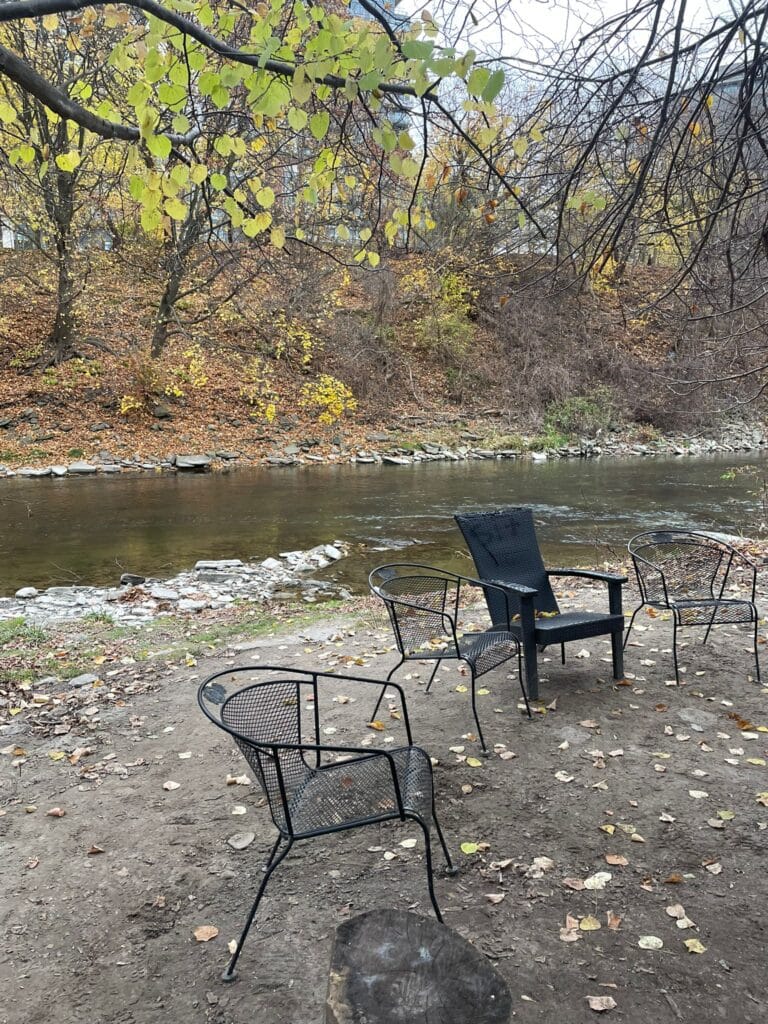
Toronto has been an important site for gathering, trading and celebration for Indigenous people for thousands of years. It is the treaty territory of the Mississaugas of the New Credit and its land and waters have been stewarded by the Haudenosaunee, the Huron Wendat and the Anishinaabe. The site of the gathering is outdoors, adjacent to the Humber River.
Get Involved
Interested in co-hosting a civic circle in your watershed or keeping informed of the In Flow series as it develops? Let us know below.
Want to co-host or stay in the know?
Join residents, artists, fire carriers, and water enthusiasts to share and explore how to help protect and restore our land and waters!
Sign up or learn more
Learn more about our process here: Casting Ripples: The potential for watershed based civic assemblies.
Want to see what past circles looked like? Read about the 2024 In Flow for Humber River.